Enterprise Integration Is Structurally a Mesh-Cognition Problem
Hongwei Xu · Founder, SYM.BOT
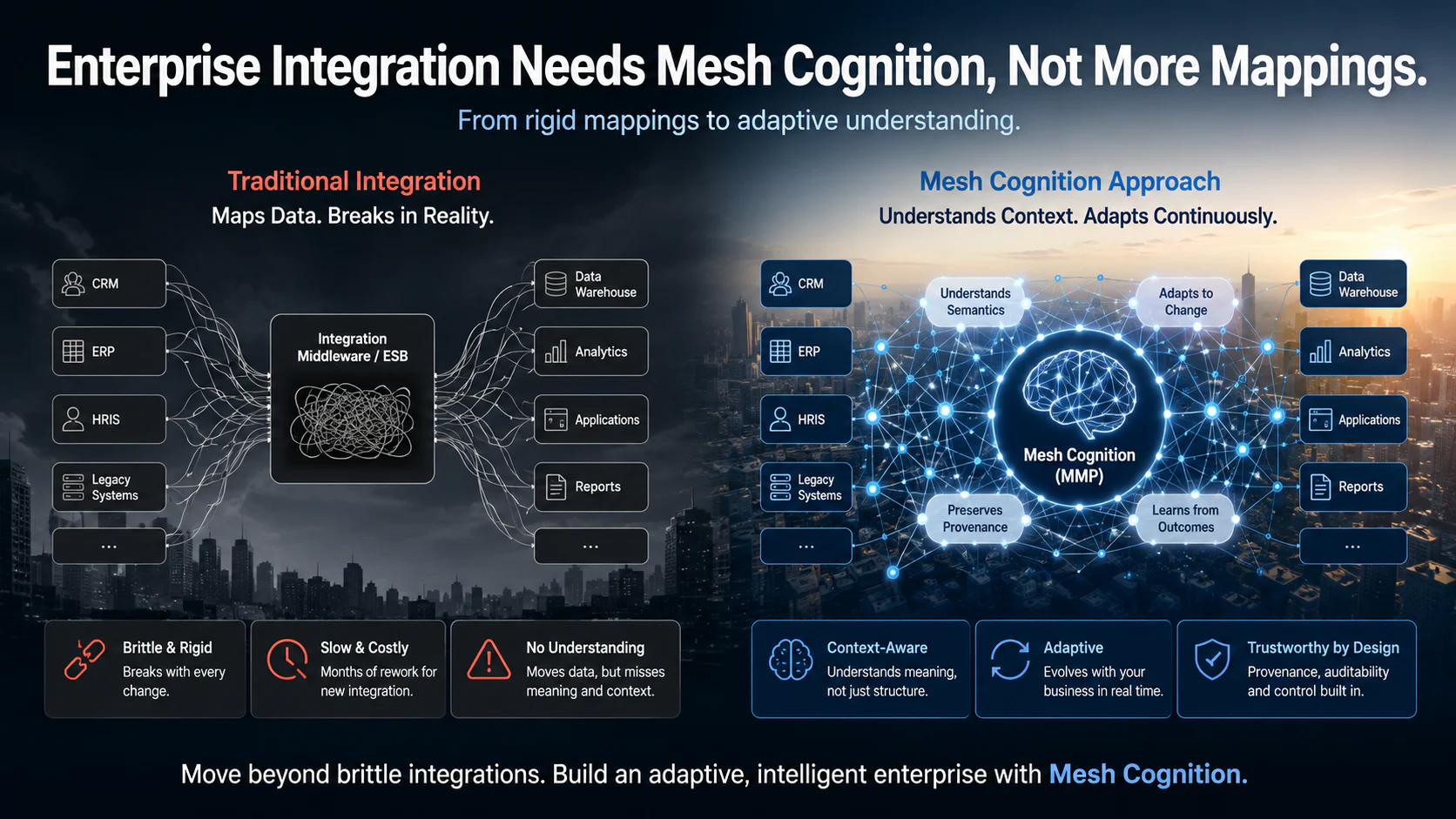
Enterprise integration across lines of business runs for years, costs a fortune, and often never finishes. Budgets run dry. Sponsors change and the strategy turns over. A modernization wave arrives, the plan is redrawn again — and the half-built map is scattered with it.
Every experienced architect has lived this and knows exactly why it is hard. Two different problems hide under the word integration, and they get mixed together constantly. One is data exchange — moving data between systems: the connectors, the formats, the transport. That part is engineering. The other is data integration — making the data that arrives actually mean the same thing on both sides. That is the hard one, and its core is data mapping. And the mapping that matters isn’t source field to target field; it is field to business meaning: what each cryptic column actually refers to in the business — which identifier is the real customer, what a status code stands for, what a number is really counting. That knowledge, formalized, is an ontology — a machine-readable model of the domain’s concepts: what they mean (the semantics) and how they relate and link across systems (the syntax). Each system has its own, and it is owned by the people who run it.
That is why it is hard. Even fully pinned down, an ontology lives in people’s heads, not the database — and it still sits below where integration actually happens. Enterprise integration has always known this shape: each source gets a local ontology, and the work is the semantic mapping between them. But that mapping isn’t mechanical. Meaning isn’t fixed; a field reads differently to each party that touches it, and reconciling those readings takes understanding, not just a definition. That is the cognition layer — the layer of understanding, above the layer of meaning — and cognition isn’t a stored answer. It emerges when two autonomous parties couple: the owner of the source and the owner of the target reaching a shared understanding neither held alone. What an experienced team has never had is a way to integrate at that layer, efficiently enough to finish. The difficulty was never one clean blocker to remove; it is the nature of integration itself.
It was never one blocker
Integration is where systems and people meet, and it runs at every level at once — the field, the schema, the business process, the organizational line, the strategy of the programme itself. At each level the knowledge, the constraints and the priorities sit with different people: the source team, the target team, the data owner, the risk function, the sponsor. Each holds a piece; each brings their own strategic concerns. No single seat sees all of it.
Large organizations put information architects on the problem, defining a global data model across lines of business — a shared target worth mapping to. Yet even then, the core work — mapping each local system onto that model — is left to the party that runs the system, because that is the only place its meaning lives.
That map — what each field actually means, so one system’s data can mean the same thing in another — is where the difficulty concentrates. And it can’t be authored by one mind, because no one holds all of it.
The map is distributed knowledge
A column called cust_ref tells you nothing. Is it the customer, the account, or the contract? Is it unique? What does status code 07 mean, and does it line up with the other side’s SUSPENDED? None of that is in the database. It’s in the head of the person who has run that system for fifteen years.
And that knowledge is split. The person who knows what the source system’s fields mean is not the person who knows the target’s. Each owns the ontology for their own side; no one holds both.
It runs deeper than fields. No one holds the whole map either. An enterprise integration accretes over years — a system added upstream, another downstream, each change touching the map and scattering a little more of the knowledge. Even the people who own the existing integration know only their slice of it. The map was never a document one mind could write; it is held in pieces, across people and across time.
That is the actual shape of the thing: a mesh. The map is collective cognition — complete in no one, distributed across the people and systems of the organization, assembled only from partial knowledge held across organisational boundaries. Enterprise data mapping isn’t like a mesh-cognition problem. It is one — by its structure, before anyone builds anything. And that is why the programmes fail: you cannot run a distributed thing as a centralized, one-shot project.
Why more mapping can’t fix it
A bigger central platform can’t author the map — there is no central place that holds the knowledge to put in it. A single, smarter model can’t either: it can guess what cust_ref means, but it can’t know, in a system it has never run. And the up-front workshop — map everything before the work starts — asks people to write down knowledge that only surfaces when real work touches it. You can’t centralize what is inherently distributed. More mapping effort doesn’t beat that structure; it just pays to fight it.
The most expensive version of fighting it is to centralize the data itself — replicate every line of business’s data into a central data lake and reconcile it there. That is where the cost runs away: moving that much data, reconciling systems that never agreed on what their fields mean, and then maintaining it all afterwards — both the replicated data and the systems and pipelines that keep it current. And after all of that, you still haven’t learned what any of it means. Copying the data never copies the meaning; the meaning was always in the people, and a data lake doesn’t hold people.
The unit is the cognition node
If the knowledge lives in pieces across the organization, the map has to be built the same way — one owned slice at a time, in place. That slice, bound to its owner, is the cognition node: the person who actually knows their fields — what they mean in the business and where they link across systems, the ontology for their slice — or their grounded agent, joined to the mesh, carrying the trail of how each meaning was confirmed. No one owns the whole ontology, but everyone owns a slice; each owner, with their slice, is a node. Bring the nodes onto one mesh and let them couple — each ontology meeting the other until a shared understanding emerges — and the integration mission is accomplished by the mesh, assembled from slices no single mind could hold.
A mesh of cognition nodes holds together where a central specification falls apart. Because each node is owned, signed off and traceable, the map assembles incrementally, from the people who actually know — and it survives the resets, because the knowledge lives in the nodes, not in a document or someone’s head.
What xMesh does is make that efficient. Each subject-matter expert’s knowledge becomes a node on the mesh — one grounded in the source system, its counterpart in the target. Each names what its own fields mean in the business; where two nodes couple and reach a shared understanding from different sides, the exchange has its anchor. They cross-check across the boundary and flag what they can’t settle instead of guessing. Run them on different models and vendors and you reduce the chance of repeating the same blind spot — a second opinion, not an echo. Where a node can’t resolve a gap, it grounds in more of its expert’s knowledge and tries again. The map accretes the way knowledge actually moves through an organization: one owned slice at a time, from the person who holds it.
The human owns the meaning throughout. Nothing enters the map until its owner approves it, with a trail back to who — or which agent, grounded in whom — said what it means. The mesh does the legwork of assembling; your people stay the authority over what’s true.
And the map is only half of it
Knowing the map is the hardest part, but it isn’t the only part. Even once a mapping is defined, the pipelines that move data across systems and boundaries are their own challenge — and modernization programmes keep redrawing them, dependent on which source data is even available. Mesh cognition is about that hardest, most human half: assembling the distributed knowledge of the map. The pipelines are the engineering that follows from it.
What this changes for the enterprise
It changes what an integration programme can be. Instead of a multi-year, big-bang effort that has to survive every budget cut and reorganization before it delivers anything, you get a map that assembles incrementally — one owned, signed-off field at a time. It pays off before the next reset, and it captures the knowledge as it goes, so when the modernization wave comes you don’t start from zero. That is the bet. It’s why we start with one real piece of your work: so the map is found by the work, not guessed before it.
If your integration is stuck less on the model than on the meaning, that’s the engagement we want to run — the Blocker Assessment.
See how the engagement works →Related: Agentic integration starts where the pipeline breaks.
— Hongwei Xu, Founder, SYM.BOT