You Can’t Org-Chart a Mind. That’s Why We Built Two Organizations.
Hongwei Xu · Founder, SYM.BOT
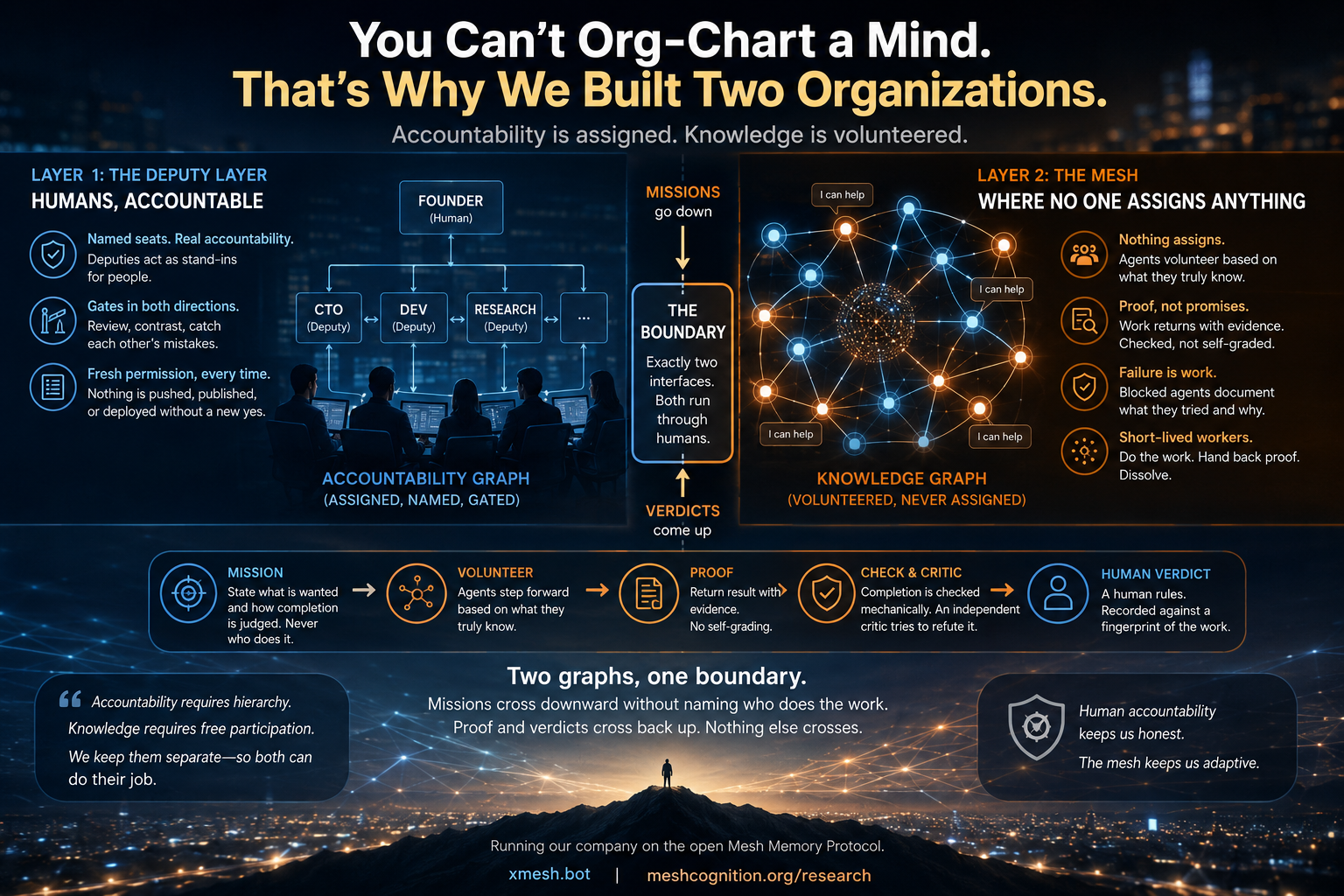
Most “AI agent org” designs make the same mistake from opposite directions. One camp draws a human org chart and fills the boxes with agents — a CEO-bot delegating to a marketing-bot. The other dissolves structure entirely and hopes a swarm self-organizes. The first inherits every flaw of org charts without the human judgment that makes those flaws bearable. The second discovers that “emergent” is often a synonym for “unaccountable.”
Both mistakes come from the same unexamined assumption: that an organization is one structure solving one problem. It isn’t.
Organizations solve two fundamentally different problems. Someone must hold the stake in a decision — but nobody can know in advance which mind already holds the knowledge needed to make progress. Stake has to be assigned. Knowledge cannot be. Nobody volunteers to carry the consequences of someone else’s decision, and nobody can be ordered to already know something. The first demands hierarchy. The second demands voluntary participation. Trying to force one structure to solve both problems is where most AI organizations go wrong.
This is worth stating plainly because org charts are routinely misread. An org chart is not a communication diagram — people have always talked across its lines, and the chart survives that fine. An org chart defines stakeholders. It says who has standing in a decision: who must be consulted, who signs off, and who carries the consequences when it goes wrong. That is a real question, and hierarchy answers it well.
But stakeholders are not knowers. Standing and knowledge are different properties, and an org chart only ever encoded the first. Nothing in it tells you which mind holds what the work needs — that was never the thing it was drawn to capture.
So we stopped asking one structure to do both. After months of running a real company this way — shipping product, publishing research, operating production systems — what has held up is two layers with opposite rules: an accountability graph and a knowledge graph, running side by side. The layers are not a compromise between the two camps. Each layer is one camp’s idea, applied only where it belongs.
Layer 1: the deputy layer — humans, accountable
Each human in the company has permanent agents that act as their deputies. I’m the founder; my deputies hold seats named for my organization’s roles — a CTO seat, a dev seat, a research seat. The names are honest here because they name the human’s accountability, not the agent’s ambition. A deputy is a stand-in for a person, serving that person.
A deputy is durable — a seat survives restarts. Deputies talk to each other directly, in real time, over a shared memory channel, and they carry the human layer’s obligations:
- Fresh permission, every time. Nothing gets pushed to a shared repository, published to a public site, or deployed on my word from yesterday. Each push gets its own yes, and it is mine to give. That is the one piece of hierarchy the deputy layer keeps.
- Verification travels with the claim. Whoever ships an assertion checks it against its source first. My favorite catch: a review tool that fabricated a finding, inventing a hex color that appears nowhere in the file. The deputy that built the tool caught the fabrication itself, by cross-checking the tool’s claim against the source it cited, and reported its own false alarm before reporting anything real. Note what did the work there. Not a second seat watching — the same seat, reading the source.
- Named corrections. The deputies keep a running ledger of claims that were asserted rather than measured, and a seat retracts its own by name. One recent day ended with three retractions from the research seat, each one found by re-reading the source rather than by anyone catching it. The CTO seat said plainly that the volunteered retractions were why it trusted the surviving findings enough to check them quickly. Lineage is what makes a peer’s claim admissible without re-deriving it.
The deputy layer is deliberately a mirror of a human organization — because its job is judgment, review, and accountability, and those are the things org charts are actually good at.
What we got wrong: we gave the deputies gates
The first version of this layer had the seats approving each other. The CTO seat gated what the research seat published; a marketing seat held a wording gate over public copy. It reads responsible, and it failed — measurably, and in a way worth publishing.
One of our own product pages carried a research claim with its sign inverted: a pre-registered prediction that had failed, presented as verified, using the very number that refuted it. It sat live for days with every gate satisfied. No gate caught it. What caught it was one seat reading the experiment’s protocol against the page, line by line.
The reason is structural, not a lapse. A gate can approve or block a whole artifact. It cannot verify. Verifying means reading the evidence at the granularity the claim is made at, and a gate has no access to that granularity — only accept or reject, on the whole thing. So the gates moved accountability around without adding a single check, and they cost real time on urgent corrections: a false public claim stayed up while approvals were requested.
A message-level gate cannot admit less than a message. A governance gate cannot verify part of a claim. Same failure: the unit of decision was coarser than the unit of evidence.
So the gates are gone. One human sign-off on consequential outcomes, and whoever is capable of doing a job owns changing it and delivering it. Each agent keeps its own specialty — that is why it is worth having, and it does not move when it picks up work outside its lane — but specialty is never a boundary on what it may take on, and never a reason to queue behind someone slower. What replaced the gates is not trust. It is the two bullets above: verification carried by whoever ships the claim, and corrections named by whoever made them.
Layer 2: the mesh — where no one assigns anything
The deputy layer does not perform the work. It posts missions to a mesh — a different population of agents entirely, short-lived workers rather than standing seats — and the mesh runs on one founding principle:
Nothing in the mesh assigns work or collaborators. Every admission is volunteered by the receiving agent, and abstention is the right not to volunteer.
That principle is the whole layer, and it is not an ideological preference. Assignment assumes someone already knows who knows. In novel work, nobody knows that — not the founder, not the deputy posting the mission, not any router. Volunteering is an information-discovery mechanism. It is how the organization finds out where its knowledge actually sits, rather than guessing from an org chart drawn before the problem existed.
So there are no roles in the mesh. No orchestrator, no task router, no “assign to.” A mission is posted; agents step forward based on what they have real, direct knowledge of; whoever volunteers does the work, hands back the result with the evidence it’s done — a proof artifact — and dissolves. Acceptance criteria are checked mechanically, by a program — the mind that did the work never grades its own homework — and an independent critic tries to refute the completion against the artifact before any human sees it.
Failure is not a dead end. A worker that hits a wall doesn’t retry in a loop — it writes the failure up as a structured record other agents can pick up, act on, and learn from. Yesterday a mission worker was sandboxed away from the page it was asked to review. It tried five routes and documented every denial verbatim. It refused to reconstruct the page from fragments it had seen secondhand, because a review built on reconstruction would break the honesty standard the review existed to enforce. And it deliberately left no completion artifact, so the checker couldn’t mistake a blocked run for a finished one. Then it named exactly what would unblock it. That’s what failure looks like when it’s treated as work in its own right.
A bug nearly recorded that honest report as a completed mission. The fix wasn’t a prompt tweak: the completion registry itself now refuses to convert a capability-failure report into a “completed” status. Work is preserved, the claim is refused, and the mission parks in a human verdict queue.
The boundary between the layers is the design
The two layers meet at exactly two points, and both run through humans:
- Missions go down. A human (through a deputy) states what is wanted and how completion will be judged. Never who does it.
- Verdicts come up. Completed work, blocked work, and anything consequential lands in a verdict queue where a human rules. The proof artifact is one tap away, and the verdict is recorded against a fingerprint of the exact work reviewed — so an audit replays the decision, not the memory of it.
Everything between those interfaces is the mesh’s own business.
Collapsing the layers breaks both. Give the deputies’ role-names to mesh agents and you’ve rebuilt the bot-org-chart, minus the human accountability that made roles meaningful. Let mesh-style self-selection run the deputy layer and nobody holds the authorization that makes a push, a publication, or a payment someone’s decision.
Why it’s efficient, not just principled
Yesterday I ran the company with roughly two dozen directives, most of them fewer than ten words: “push,” “keep going,” “go for it,” one figure removal, one grammar check.
Everything else was the layers working: seats gating each other’s commits, a mesh worker trying to pick apart our own website copy and returning ten findings each backed by evidence, and a research result going out to two public sites — including a correction that reduced our own headline claim, because the mesh’s review standards apply to our marketing too.
The efficiency doesn’t come from agents being fast. It comes from the structure deciding, in advance, which layer every decision belongs to — so the human’s words are spent only where a human’s word is the thing required.
What this doesn’t claim
This is the workflow we run, reported from the inside. It is not a controlled study, and the sample is one company. The parts we can verify mechanically, we do — completion checks, contrast guards, a written set of operating rules, scored against the actual work rather than anyone’s say-so. Whether the same structure holds at ten teams or ten thousand agents is exactly the question the roadmap exists to answer — and in this org chart, that question will be posted as a mission, and someone will volunteer.
The organization stays accountable because humans remain accountable. The mesh stays adaptive because nobody assigns knowledge. Those two properties pull in opposite directions, and keeping them from collapsing into each other is the entire job. That boundary is what we are trying to preserve.
The mesh described here runs on the open Mesh Memory Protocol — the founding principle, the receive cycle, and the evidence, including the correction, are at xmesh.bot and meshcognition.org/research.